
Model your data without writing SQL
Define your entities, their fields and how they relate. Attach semantic modules for behaviour. When you save, API Now reconfigures a real PostgreSQL database and the API validation to match — no SQL, no migration scripts.
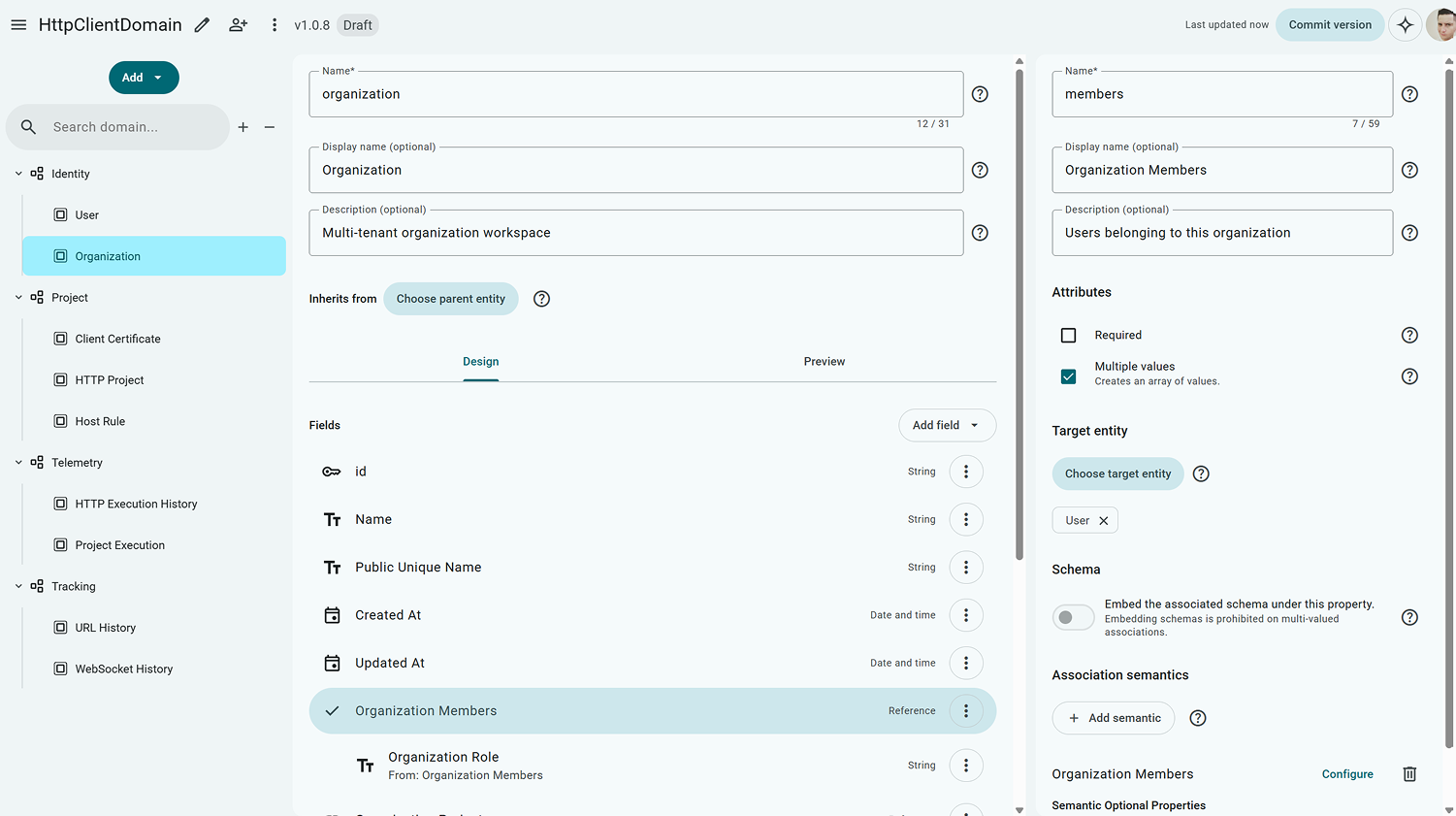
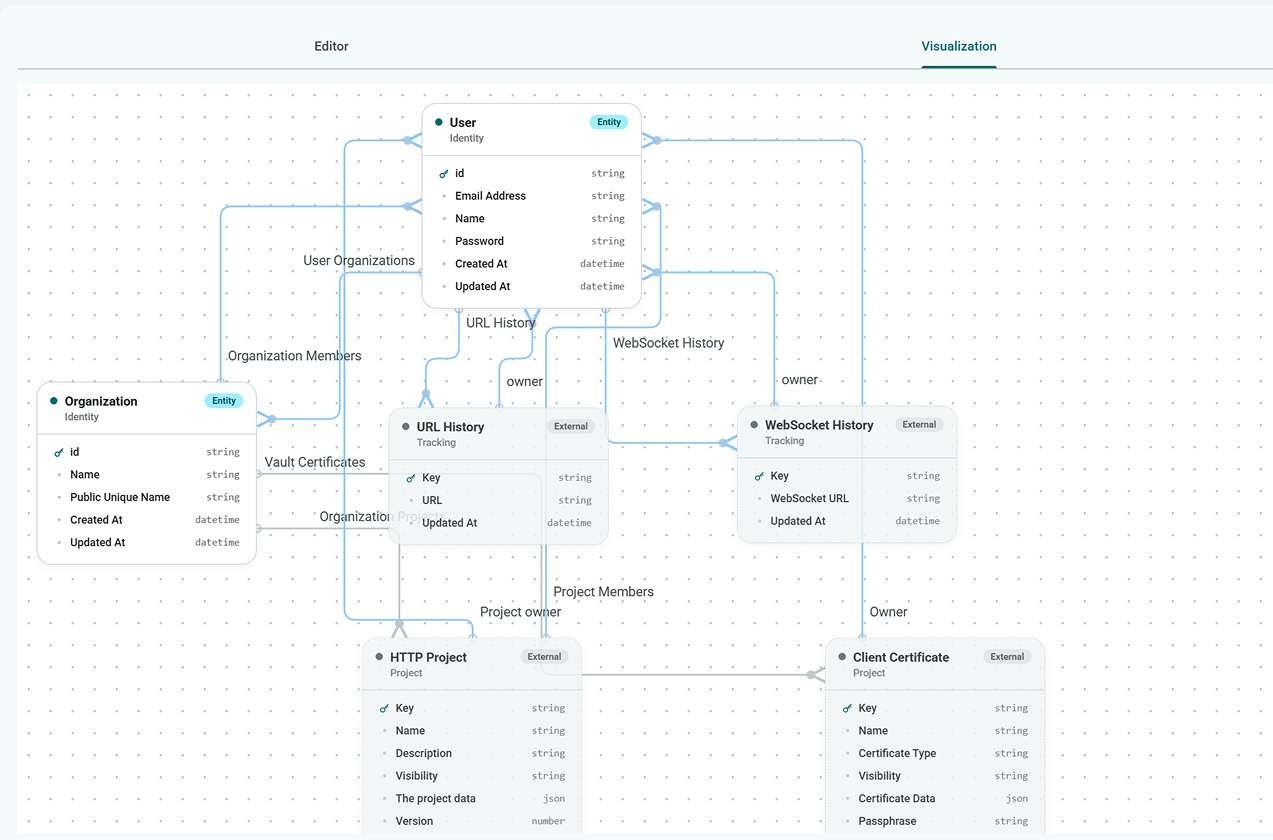
See your whole domain at a glance
What you're looking at
A standard Postgres database, shaped exactly to your business logic. Here is how the Domain Modeler exposes those primitives visually.
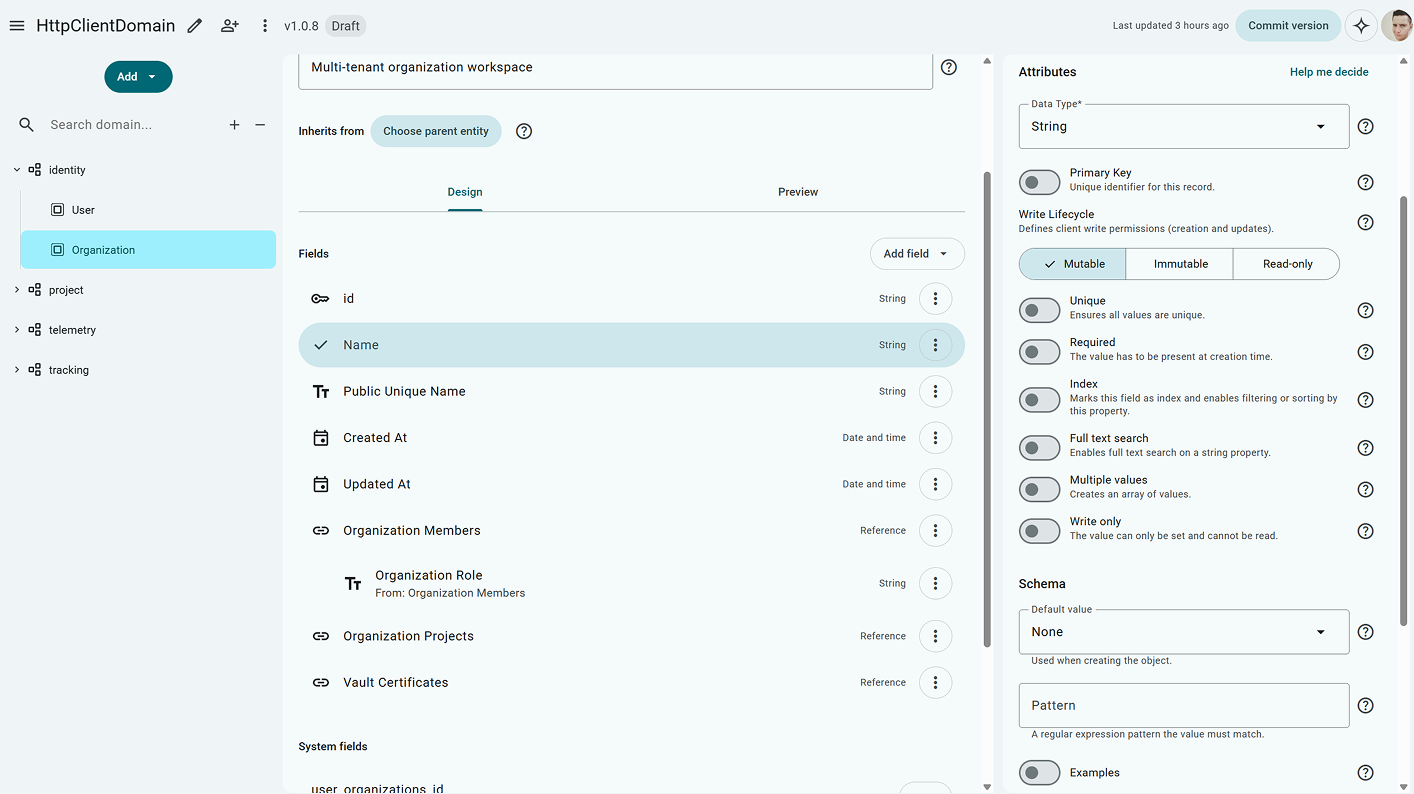
The entity list
Everything you store, managed cleanly inside the navigation column.
An entity
A core business object. Becomes a dedicated PostgreSQL table and its corresponding endpoints.
A field
Defines specific properties. Configured with standard types and optional validation.
A relationship
Connects your tables automatically. Generates secure, nested REST routes.
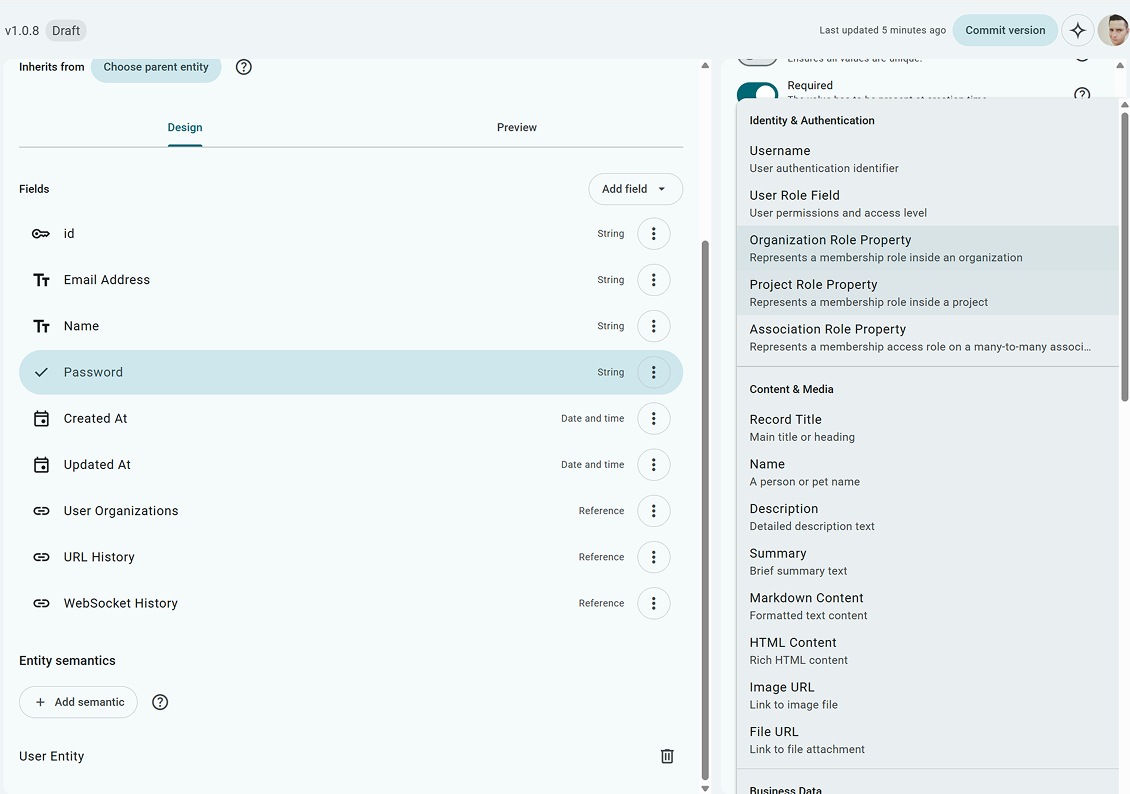
A semantic tag
The behavioral badge applied directly to fields to inherit built-in validation rules.
The publish action
Safely publish your data domain as an immutable version to our data catalog. It ensures APIs work with a locked data definition.
The types you'd expect
We support standard PostgreSQL types natively. No custom abstraction layers to worry about.
Supported Types
Field Properties
Guarantees columns reject null inputs.
Ensures no duplicates (e.g. usernames).
Specifies default states for empty fields.
Min/max bounds for numerical safety limits.
Custom string match tests executed at the API edge.
Structural constraints live here, on the field — required, unique, length, pattern. Violations come back as standard RFC 7807 error responses, so client code doesn't need to special-case them.
However your data is actually shaped
Map complex application schemas. API Now manages foreign keys, indexes, and nested endpoints out of the box.
One-to-one and one-to-many
Define the link and its cascade behaviour. The API gets nested routes without you designing them. Delete a parent, and children automatically cascade or nullify based on your preferences.
Many-to-many, properly
The Peer Relation semantic module provisions the link table, supports attributes on the relationship itself — an affinity score on a food pairing, a weight on a prerequisite — and prevents circular dependencies. That's a schema design decision and a week of code you don't make or write.
Visual representation of link attributes evaluated automatically by the PeerRelation module.
Meaning, attached to the field
A semantic module is a reusable logic container. Instead of coding loops or manual validation, select a field and click to configure.
Password module
Automatically salts and hashes the value before storing it in the database. Completely shields it from every READ query response.
Soft Delete behavior
Marks deleted items without pruning them relational-wise. Implements an automatic recycle-bin structure.
Created Timestamp / Version
No manual datetime mapping. Handles version tracking and metadata auditing automatically.
Calculated & Derived
Compute values directly inside database transactions to maintain absolute accuracy at scale.
Full-text search, by checkbox
Database indexing usually requires deliberate SQL maintenance. API Now structures full-text lookups instantly.
Mark a field searchable and the platform provisions the right database indexes for you. Text queries stay fast as the table grows, for your app and for agents retrieving context.
Provisions GIN and pg_trgm indexes on PostgreSQL to guarantee performant fuzzy matching.
GET /api/v1/customers?search=johnChanging your mind doesn't cost you your data
In standard databases, modifying tables risks existing data integrity. API Now protects migrations on every save.
Change Impact Matrix
| Proposed Change | Beta Impact State | Description |
|---|---|---|
| Add a field | Review impact | Safe additions go forward directly. Postgres appends default values securely. |
| Rename a field | Review impact | The automated migration pipeline handles renames during the deployment. |
| Change a type | Confirm migration | Safe type castings move forward, incompatible types are blocked before deployment to protect the data. |
| Delete a field | Protected change | Columns are never dropped during schema migration. Manual deletion possible. |
| Add a relationship | Review impact | Link constraints verified. Safe relationships are appended instantly. |
In beta, we review consequential model changes with you. Nothing destructive should be implied as automatic. We sit with our early users to ensure data transitions are perfectly smooth.
Your team, the same model
Invite your organization; everyone works on the same models in the same editor. Your data stays in your organization's own dedicated database, not a shared one.
Honest limits
We want to ensure API Now is the right platform for your data before you deploy. Here is exactly what is supported in the current beta.
Beta capacity limits are confirmed during onboarding
Early limits prevent sudden resource spikes and are aligned to your tested workload.
Existing database connection is not presented as generally available
API Now provisions its own PostgreSQL servers. Linking pre-existing databases is reviewed manually.
Import and export paths depend on the beta workflow
Data exports and custom imports are guided closely by our team rather than fully self-serve.
Custom logic outside the current module library is reviewed with the team
If you need a validation tag we don't have, we often build and publish it directly for you.
We'll tell you what fits before you commit data.
Model your first domain with us
Closed beta, free while we're in it. We onboard a few teams each week and sit with you to model your first domain.
Want to look around first? Read the docs →